
Championing a Symphonic Pioneer
Listener inquiries about historical BAME composers increased during the broadcast weeks of August 4 through August 18, and that told us something practical: the appetite was not for token discovery, but for deeper listening. Florence Price belongs at the centre of that listening, not at its polite margin.
Price was a woman composer of African descent writing inside, against, and beyond the inherited structures of American concert music. Her orchestral works do not merely add local colour to European forms. They test the symphony as a civic argument: whose dance rhythms count, whose spiritual idioms are treated as architecture, whose development sections are allowed to carry historical memory.
The episode’s mission is therefore direct. It centres an underrepresented voice in the classical canon by treating Price’s symphonic writing as repertoire, not recovery work. That distinction matters. Recovery says, “Isn’t it good we found her?” Repertoire asks, “How should we rehearse the inner voices, pace the Juba, balance the brass, and programme the work next to William Grant Still, Ulysses Kay, George Walker, Adolphus Hailstork, Margaret Bonds, or Chen Yi without flattening the differences between them?”
Elizabeth de Brito, as producer and creator, guides that musical exploration with the discipline of someone who understands both broadcasting time and historical absence. For this Price episode, the runtime expanded from the standard 45 minutes to a full 60 minutes because the longer symphonic movements needed breathing room. A clipped format would have distorted the argument before the music had even begun.
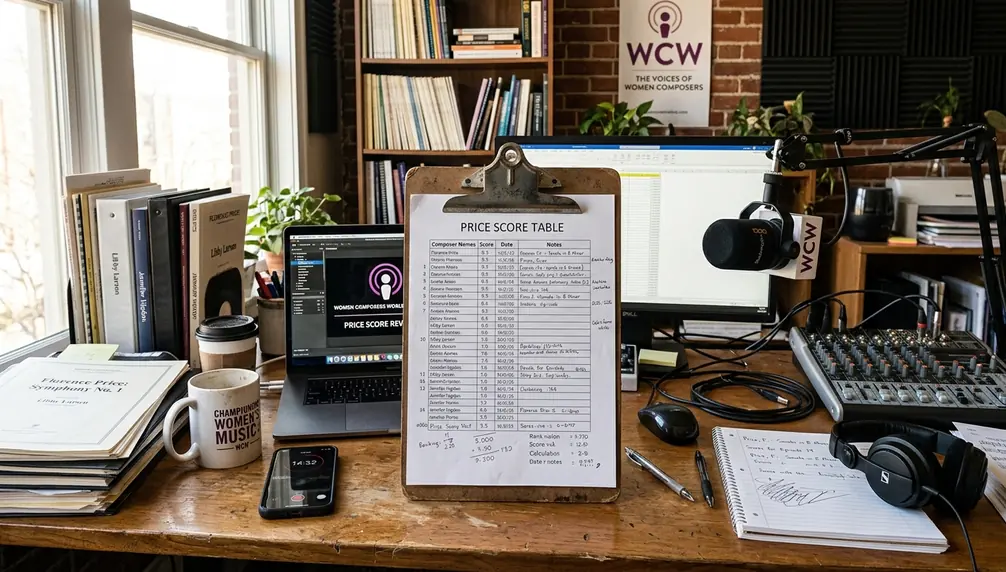
Main Point: Programming for justice is not a slogan here; it is a method of listening long enough for the orchestral evidence to speak.
Criteria for Selection: Framing the Repertoire
The first draft of the awards framework looked tidy, which is usually the moment I start worrying.
Initially, the curation team considered restricting the orchestral category to works premiered within the last decade to emphasize contemporary composers. That approach was discarded because it would have made historical neglect look like present-day absence. If a work by Florence Price has been structurally excluded from programming, recordings, and scholarship, a narrow premiere-window rule can punish the very repertoire the project is meant to illuminate.
The Daffodil Perspective Awards operate as an annual classical music award system, but the word “annual” should not be mistaken for shallow topicality. The public consultation period for the award categories ran between October 14 and November 1, 2019. That bounded consultation matters because category design can quietly decide which composers appear eligible before anyone hears a note.
The award’s focus on the BAME demographic is organised through three specific categories: Instrumental, Orchestral, and Opera. For the Orchestral category, eligible recordings must feature a minimum of 12 instrumentalists, which separates it from the Instrumental chamber category. That threshold is blunt, but useful. It prevents a string quartet, piano trio, or small mixed ensemble from being judged against symphonic writing simply because both sit under the loose public label of “classical.”
In our review, one catch proved especially important: the 2019 release year eligibility requires a full commercial album or EP release. Standalone promotional singles distributed outside standard physical or digital channels are excluded from the ballot. For this repertoire, manuscript survival and recording availability still shape what can be fairly compared.
This is where Price complicates easy administration. Her symphonic works often arrive through a chain of archival survival, editorial reconstruction, performance advocacy, and commercial recording. That chain is not the same as the route taken by a newly commissioned orchestral album. The criteria therefore have to keep two obligations in view at once: respect the rules of a contemporary award system, and refuse to let those rules erase historical composers whose materials reached us unevenly.
Expert Tip: When evaluating an orchestral work by an underrepresented composer, separate three questions before making a programming decision: what survives in the archive, what has been edited for performance, and what has been commercially released.
4 Essential Symphonic Works by Florence Price
Price’s symphonic writing rewards comparison, but not the lazy kind where every Black composer is made to represent the same cultural thesis. Florence Price is not William Grant Still with different orchestration, nor is Margaret Bonds simply a vocal analogue to Price’s symphonic imagination. The value lies in the particular technical choices: phrase extension, modal inflection, dance placement, brass weight, percussion restraint, and the pressure she applies to inherited forms.
1. Symphony No. 1 in E Minor
Symphony No. 1 in E Minor is the necessary starting point because its historical significance is inseparable from its craft. The work won first prize in a major national composition competition in 1932, bringing a cash award of about $500. That fact matters, but I would not stop there; prizes can draw attention, while structure explains endurance.
The symphony blends traditional classical forms with African American spiritual idioms without treating either as decorative. Its large-scale argument depends on symphonic expectation: thematic return, contrast, development, and cumulative weight. Yet Price bends those expectations through melodic contours and rhythmic gestures that carry Black musical memory into the concert hall on structural terms.
The Juba-related writing is a useful test case. The tempo interpretation of the Juba dance movements varies significantly depending on whether the conductor emphasizes the classical scherzo tradition or the underlying African American folk rhythms. A brisk, polished scherzo can make the movement sound elegant and slightly detached. A rhythmically grounded reading can reveal its social charge without sacrificing symphonic discipline.
2. Symphony No. 3 in C Minor
Symphony No. 3 in C Minor speaks with a denser orchestral vocabulary. It was commissioned by the Works Progress Administration, and that context places the work inside a New Deal-era conversation about public art, labour, and American cultural identity. Price does not respond with a poster version of nationalism. She writes textures that feel more mature, more compressed, and more aware of orchestral colour as argument.
I listen here for the way instrumental groups answer one another. The writing does not simply stack strings, winds, brass, and percussion into a bigger sound. It stages pressure between them. The result is a symphony that can withstand close rehearsal because its substance lies in transition, balance, and register as much as in theme.
For broadcasters and programmers, this is the Price work that often benefits most from guided listening. A listener who expects only the open lyricism associated with some readings of the First Symphony may miss the tighter dramatic syntax of the Third. Give the audience a few technical handles before the movement begins, and the architecture becomes far more audible.
3. Symphony No. 4 in D Minor
The manuscript history of Symphony No. 4 in D Minor has become part of the work’s modern identity. The manuscript was discovered in an abandoned summer home in Illinois, alongside dozens of other works, during a property renovation in 2009. That discovery remains one of the clearest reminders that archival absence is not the same as compositional absence.
Readers who want to understand the archival trail should consult Florence Price's original manuscripts and papers. Manuscripts do not arrive as neutral objects. They arrive with gaps, copyist questions, inconsistent markings, and the practical demands of turning a surviving source into a rehearsable score.
Caution: Attempting to program Price’s Symphony No. 4 using the original unedited manuscript often results in rehearsal delays due to missing articulation marks in the brass section.
That warning is not an argument against programming the work. It is an argument for preparation. Conductors should identify which edition is being used, clarify articulation decisions early, and give brass principals enough time to resolve ambiguities before the first full rehearsal. The reward is a symphony that extends the Price conversation beyond the familiar milestone of the First.
4. The Mississippi River Suite
The Mississippi River Suite sits slightly differently in the ear because it invites the listener to think in scenes, currents, and episodes rather than in the stricter expectations of a numbered symphony. I include it in this guide because symphonic understanding should not be reduced to works with “Symphony” in the title. Orchestral imagination can take the form of a suite and still carry large-scale cultural argument.
The piece is especially useful for teaching Price’s handling of musical reference. A suite can move quickly between contrasting materials, which makes the composer’s decisions about continuity more exposed. Does a transition feel pasted, or does it create a convincing route between expressive worlds? With Price, the best performances make those joins feel deliberate rather than illustrative.
For programming, the suite can also sit well beside orchestral works by composers from different strands of the BAME repertoire, provided the pairing has a real musical reason. Put it next to Still for questions of American orchestral identity, or near Chen Yi if the programme is asking how composers transform inherited material into concert form. Do not pair by demographic label alone; audiences hear the thinness of that logic immediately.
Important Production Update and Hiatus Notice
The broadcast schedule changed because of Elizabeth de Brito’s road accident in September 2020. The September 25, 2020 broadcast was officially cancelled just 48 hours before airtime following the accident.
The show is on hiatus until October. That decision was not made for convenience or as a soft pause in production. Medical recovery protocols restricted the producer’s screen time to roughly 15 to 20 minutes per day for the first three weeks of October, which made normal preparation, editing, correspondence, and broadcast administration impossible to sustain responsibly.
The choice to disclose the medical reason for the hiatus was made to maintain transparency with the supporter base. In a small cultural project, silence can create needless speculation; too much detail can become invasive. Here, the relevant point is practical: concussion-related recovery limits screen work, and this programme depends on concentrated listening, scripting, file management, and communication.
That interruption does not diminish the purpose of the Price episode. If anything, it clarifies the labour behind this kind of advocacy. Bringing Florence Price’s symphonic works to listeners requires more than admiration. It requires archives, editions, airtime, careful category design, and producers healthy enough to do the work with attention.
When broadcasting resumes, the guide should be heard in that spirit: not as a memorial gesture, and not as a seasonal correction, but as part of a longer practice of programming for justice. Price’s orchestral catalogue deserves the same serious technical engagement we routinely grant to the established canon. The evidence is in the scores; our task is to stop treating access to that evidence as accidental.





Add Your Thoughts