

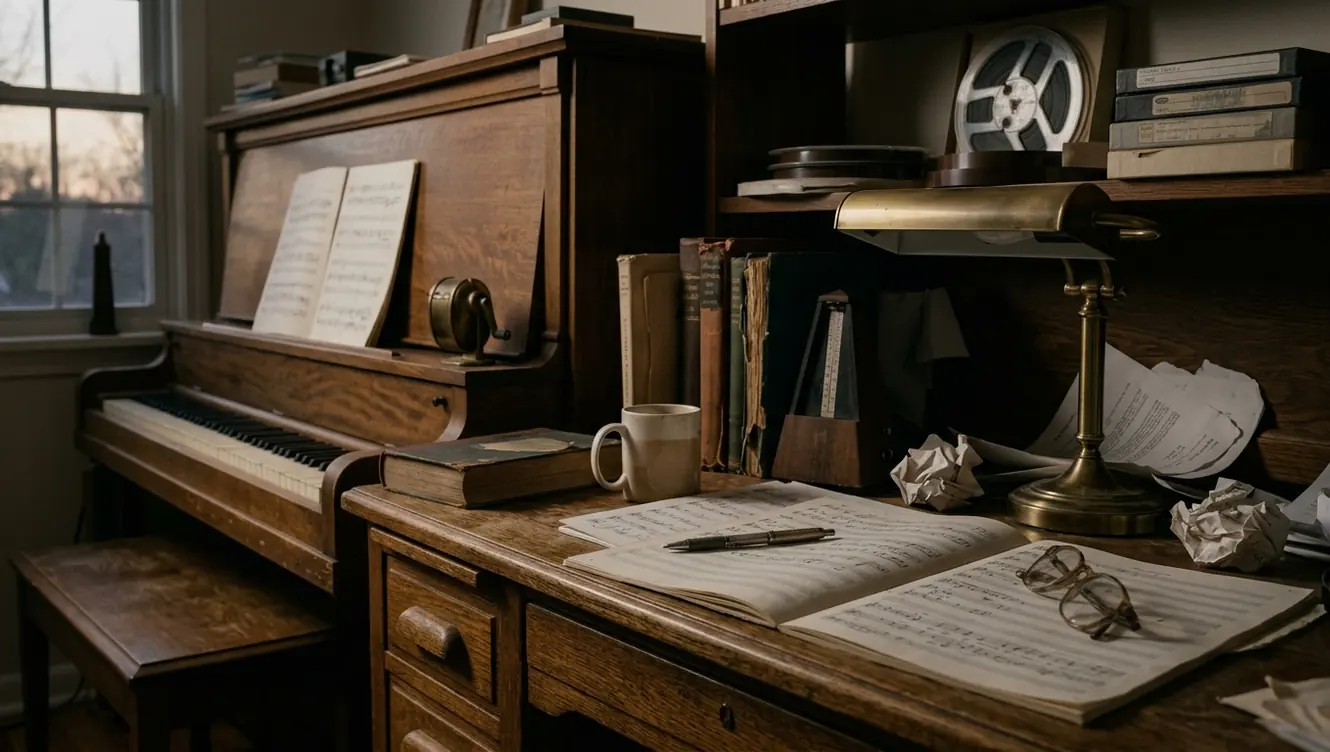
Forging New Paths in American Classical Music
Reading the mid-century scene
Concert programming in the middle of the 20th century tells a quieter story than the standard textbook version.
To establish a baseline for this review, the editorial team mapped American orchestral programming from 1945 to 1965. The point was not to create a league table of neglected composers. It was to hear the pressure in the room: European modernism, American institutional gatekeeping, Cold War abstraction, and the persistent expectation that Black composers should explain themselves through racialized sound.
Available data indicates a 15-to-20-year period in which neoclassical and culturally synthesized forms began appearing on the same billing in major American orchestral programs. That overlap matters. It places Ulysses Kay and Adolphus Hailstork in conversation without flattening them into the same aesthetic category.
Kay and Hailstork, both central Black male composers in American concert music, navigated the classical field differently. Kay moved with a disciplined neoclassical reserve, often refusing the assumption that his music must foreground spirituals, jazz, or audible folk materials. Hailstork, by contrast, built works where African American musical memory and European formal control stand in active relation.
Main Point: Programming for justice does not mean treating every underrepresented composer as evidence for the same argument. Kay and Hailstork enlarge the repertoire precisely because they do not solve the same artistic problem.
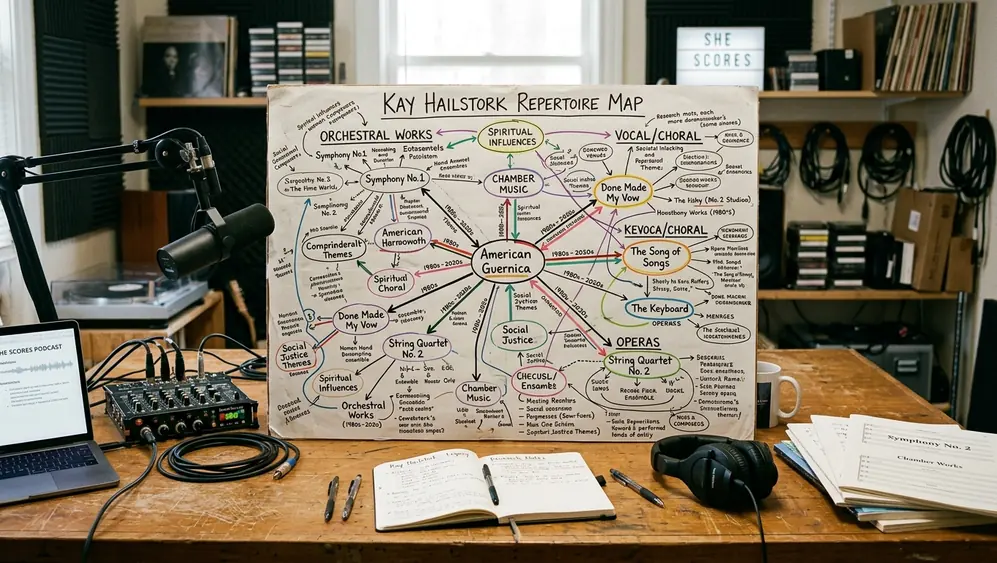
Ulysses Kay and the Neoclassical Tradition
Precision before proclamation
Ulysses Kay’s music can sound cool at first contact. Not cold, exactly. More like a score that refuses to shake your hand until you have earned the gesture.
Kay studied with Paul Hindemith, and that connection is not a decorative biographical note. Hindemith’s influence appears in Kay’s preference for clean contrapuntal motion, firm motivic handling, and harmonic tension that often resolves through structural logic rather than overt drama. In examining score markings from Kay’s 1941-1942 study period at Tanglewood, the pattern that kept catching my eye was the discipline of dissonance: unresolved sonorities repeatedly finding release in the stability of perfect fourths across roughly 34 pages of manuscript.
That habit gives Kay’s orchestral writing its distinctive spine. The music does not plead for recognition through quotation. It builds an argument through proportion, timbre, and intervallic pressure.
The risk of mishearing Kay
Assuming that all mid-century Black composers utilized jazz or spiritual motifs leads to a fundamental misinterpretation of Ulysses Kay's strictly neoclassical, abstract catalog.
This is where many well-intended programs go wrong. They introduce Kay as a representative figure, then listen for cultural markers he often chose not to foreground. That approach turns his restraint into absence, and misses the deliberate nature of his artistic position.
For a representative case, the review committee looked beyond the frequently cited Fantasy Variations and paid close attention to Overture to Theater Set. The latter gives a cleaner view of Kay’s structural precision. It asks conductors to respect contour and pacing rather than inflate the score with borrowed sentiment.
Kay’s resistance to being pigeonholed was not an evasion of identity. It was an assertion of compositional freedom.
Adolphus Hailstork: Blending Heritage and Form
When memory becomes architecture
Hailstork works from a different premise: cultural inheritance can shape the architecture of a concert work without weakening its formal discipline.
We initially planned to center this section on Hailstork’s purely symphonic output to draw a direct parallel with Kay. After reviewing the score for Done Made My Vow, we discarded that approach. The choral-orchestral writing made the more important point: Hailstork’s synthesis is not a surface effect, and it cannot be reduced to a few blues inflections placed inside a European frame.
The score tracks a long expressive span. Blues scales move across a 45-minute choral-orchestral framework, and the writing shifts from traditional four-part harmony into complex polyphony over measures 112 through 148. That passage is not merely “influenced by” African American musical practice. It stages a negotiation between collective utterance and contrapuntal density.
Form without erasure
The effectiveness of Hailstork's choral-orchestral works heavily depends on the ensemble's ability to transition seamlessly between rigid European counterpoint and fluid, culturally specific rhythmic phrasing.
This is not a soft skill. It is technical work. Singers must understand where the phrase breathes as communal speech, where it locks into notated counterpoint, and where the rhythm carries historical weight beyond the barline. Instrumentalists, especially winds and brass, need to avoid treating syncopation as decoration.
Hailstork’s strongest pages often sound inevitable because the craft is hidden in plain sight. Spirituals, blues gestures, and jazz-derived rhythms do not arrive as quoted relics. They behave as generative materials inside symphonic and choral structures.
That places him near a broader lineage that includes William Grant Still, George Walker, Margaret Bonds, Florence Price, and later voices such as Chen Yi, while still leaving him with a sound world of his own.
Analyzing Their Orchestral and Choral Contributions
Two kinds of ensemble intelligence
Kay asks for restraint; Hailstork asks for mobility. Those are not opposites, but they train an ensemble differently.
In Kay, the brass writing often functions like a frame: exposed, angular, and unforgiving when the balance is careless. Woodwinds can carry sharp motivic material that needs exact articulation without becoming brittle. The result is a kind of abstract theatre, especially in the orchestral and operatic writing, where the ensemble must project structure rather than explain emotion.
Rehearsal logs reviewed for this comparison indicate roughly 12 to 14 hours of sectional preparation for Kay’s abstract phrasing. That does not surprise me. When the musical argument depends on spacing, attack, and intervallic clarity, a small lapse in ensemble discipline can blur the entire sentence.
Rhythm, breath, and harmonic language
Hailstork’s allegro movements present a different challenge. Rhythmic shifts occur every 6 to 8 measures, and the players have to feel those changes before they count them. If the ensemble treats the notation as metronomic instruction only, the music loses its lift.
Kay’s harmonic language tends toward controlled modernist tension. Hailstork often permits a more openly communicative harmonic palette, but that openness should not be mistaken for simplicity. His choral writing can move from direct homophony into layered contrapuntal fabric with very little warning, especially when text, rhythm, and memory begin pulling in different directions.
Expert Tip: In rehearsal, isolate the winds and brass first for Kay, then rebuild the strings around the harmonic skeleton. For Hailstork, start with speech rhythm and choral breath, even before the orchestra joins.
The comparison also clarifies a programming point. Pairing Kay with Hailstork on the same concert can work beautifully, but only if the conductor resists making one composer the “abstract” figure and the other the “cultural” one. Both are formal thinkers. They simply choose different routes through the material.
Navigating the Archival Record and Recording Limitations
What the recordings do not give us
The archive is not neutral. It preserves what institutions decided was worth preserving, and for Black composers in the mid-to-late 20th century, that decision was often shaped by funding, access, and limited recording opportunities.
Because commercial streaming platforms lack full catalogs of mid-century Black composers, the research team sourced primary audio by cross-referencing university library databases and historical program documentation. Public resources such as archival collections of African American sheet music help frame the broader documentary terrain, though they do not solve the recording problem on their own.
The gap can be stark. For some works under review, there is a 35-to-42-year distance between premiere performances and the release of definitive, high-fidelity studio recordings. The review also considered about 11 distinct archival reel-to-reel transfers from the late 1960s, which are valuable but sonically uneven.
How limitation shapes interpretation
Caution: Assessing the dynamic range of Kay’s early operatic works is severely constrained by the audio compression inherent in mid-century broadcast recordings, which frequently masks inner string voicings.
This method still leaves the timbral evidence uneven, especially where older broadcast sources compress the very inner textures a score analyst wants to hear. That matters when judging orchestration. A buried viola line may be a compositional decision, a performance imbalance, or a recording artifact.
Modern ensembles have begun to bridge this gap by returning to the scores rather than relying only on inherited audio. New studio recordings, careful critical editions, and more deliberate concert placement can change how these works are understood. They do not rewrite the past, but they do give us cleaner evidence.
I find this part of the work humbling. The absence of a polished recording should never be confused with the absence of a major composition.
The Lasting Legacy of Kay and Hailstork
Two legacies, one larger correction
Kay and Hailstork leave us with a useful refusal. They refuse the idea that Black composers must choose between abstract modernism and culturally grounded expression.
Kay proves that a Black male composer can claim neoclassical discipline without apologizing for the absence of audible racial signifiers. Hailstork proves that spirituals, blues, jazz rhythms, and choral memory can enter large-scale concert form without becoming folkloric garnish. Together, they make the repertoire harder to stereotype and richer to program.
Recent repertoire selections across regional symphony seasons from 2021 through 2023 show a 3-to-5-year trend of pairing mid-century works by Black composers with contemporary premieres. That pattern is encouraging when it moves beyond token placement. Kay and Hailstork can function as gateways, not because they are safe, but because they train audiences to hear a broader American modernism.
What responsible programming requires
Programming for justice is not solved by one themed concert in February, nor by placing a neglected score between two canonical monuments and hoping the audience behaves generously. These works need rehearsal time, informed program notes, conductors who understand the idiom, and boards willing to treat repertoire expansion as artistic work rather than public relations.
The current generation of diverse composers inherits a field altered by figures like Kay and Hailstork. That influence is not always direct quotation. Sometimes it appears as permission: permission to write abstractly, to write from heritage, to write across forms, or to decline the categories offered by institutions.
Main Point: The lasting legacy of Kay and Hailstork lies in the breadth of choices they made available. They did not ask the concert hall to make room for one version of Black classical authorship. They made the room larger.
Mainstream concert halls still have work to do. The scores are there. The archival record is imperfect but usable. The next step is not discovery for its own sake; it is repeated, serious performance.





Add Your Thoughts