

Make Unfamiliar Repertoire Easier to Schedule
Vague complaints sent to a station’s general inbox leave the practical work untouched: finding a recording, checking its timing, identifying the performers and deciding where it belongs. Meanwhile, historic music by women and Black, Asian and minority ethnic composers stays out of circulation, and familiar repertoire keeps filling the broadcast log.
A usable pitch gives the music director enough information to make a programming decision.
Scheduling software draws on recordings already indexed in the station library. Familiar selections arrive with durations, composer details and ensemble tags attached. Introducing another recording creates cataloguing work, often for someone who also presents programmes or handles other station duties. Enthusiasm helps; preparation gets the proposal closer to air.
I start by choosing one recording and identifying its most plausible broadcast slot. That keeps the research focused. A short orchestral miniature needs a different argument from a complete Romantic symphony.
Programming for justice includes this practical labour: making neglected repertoire easy to find, assess and schedule while preserving the composer’s musical identity.
Find the Person Who Shapes the Music Library
A presenter introduces the music. A traffic manager coordinates scheduled announcements and underwriting. The Music Director or Program Director usually has the clearest responsibility for repertoire policy, rotation categories and library acquisitions. At smaller stations, one person may hold several of these responsibilities.
Check the staff directory and programme pages before sending anything. Use the station’s published contact route for music submissions where one exists, addressing the relevant person by name.
Listen for a Suitable Opening
- Separate local programmes from syndicated output. Concentrate on broadcasts whose repertoire the station selects itself.
- Read playlists across several weeks. Look for chamber music hours, regional features, composer portraits and recurring themes.
- Identify an existing connection. A programme exploring orchestral colour offers a stronger opening for a distinctive miniature than an unrelated anniversary appeal.
A brief drive-time selection asks for a small place within an established sequence. A multi-movement symphony needs room in a longer concert programme, along with more substantial presentation notes. Pitch each at the appropriate scale.
Make the connection explicit: “Your recent chamber programme paired contrasting string textures; this recording offers another direction for that series.” Use an actual programme reference. The director should recognise their station in the proposal.
Write an Email the Producer Can Use Immediately
Picture the producer opening your message while preparing the next programme. The composer’s name is unfamiliar, another task is waiting, and the first paragraph runs to a screenful. Give that reader a clear route through the proposal.
Keep the email compact enough to scan, with context and technical details in separate paragraphs.
Build the Pitch in This Order
- Subject: “[Composer]: [work], [exact duration], for [programme name].” Add an anniversary or concert connection only when relevant.
- Opening: Explain why this particular recording suits this particular programme.
- Spoken introduction: Supply a two-sentence biographical hook connecting the composer’s circumstances to something listeners can hear.
- Track details: Give the work and movement titles, performers, instrumentation, exact duration, label, catalogue number, track number and ISRC where available.
- Listening and delivery: Provide an authorised preview link, then explain how the station can obtain the broadcast master or commercial CD.
For the spoken introduction, choose one musical detail: a recurring rhythmic figure, a solo instrument emerging from the ensemble, or a change in orchestral texture. Add a concise historical connection rather than compressing an entire biography.
Where a relevant episode exists in The Daffodil Perspective podcast archives, identify its title and the passage that helps explain the work. Pair that context with an authorised recording reference. This gives the host a listening route and a basis for their own introduction.
Mark quoted wording clearly. Keep your proposed script separate from quotations and identify the source of any historical claim.
Check the Recording Before Offering It for Broadcast
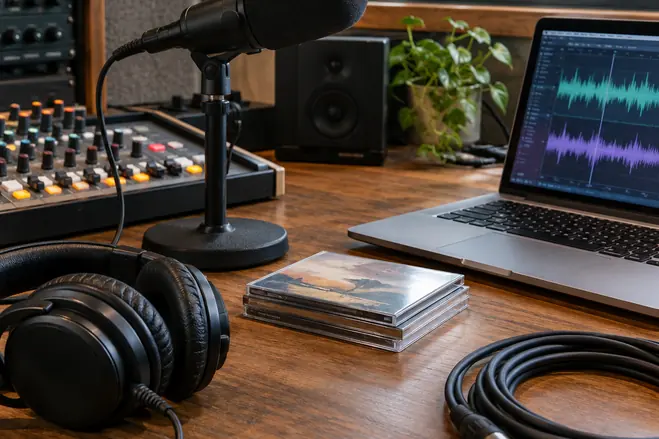
A clean commercial release gives the programmer a more straightforward starting point than an unmastered recital recording. Audible clipping, intrusive audience noise or uncertain permissions introduce work before anyone can consider the music’s place in the schedule.
Listen through the complete proposed track. Check its opening, quiet passages and ending as carefully as its loudest section. Confirm that the duration belongs to that recording and movement, including the actual ending rather than a streaming display rounded to the nearest minute.
Keep Rights and Delivery Separate
Verify the release through the label or authorised distributor. Record the catalogue details and ask where broadcast-quality audio can be obtained. For an independently issued recording, identify the person authorised to supply it and document the permissions offered.
A catalogue number or ISRC identifies a release; the station must still check its licensing arrangements for the intended broadcast and any online transmission. Let its staff handle that assessment with clear information about the recording and rights contacts.
Offer a secure download route or a physical acquisition source. Ask which audio format the station accepts before arranging delivery, and leave the original dynamics intact.
Keep Masters Separate
Send a lightweight listening link in the initial email. Deliver the uncompressed master through the station’s preferred route once requested, keeping large audio attachments out of the first approach.
Build a Relationship Beyond the First Broadcast
Set a two-week reminder after sending the pitch. If you follow up, bring something useful: a confirmed local performance, a relevant anniversary or a clearer acquisition link. Keep the original subject line so the director can recover the details quickly.
When the work airs, thank the station with the composer, work and programme named. Share the station’s programme page or authorised listening link on social media. Describe a musical moment that caught your attention; specific responses tell staff what listeners actually heard.
If the broadcast carried a local underwriting credit, a sincere note to that business can explain why you value its support for the station. Encourage fellow listeners to write in their own words. Genuine responses give the station something more useful than duplicated campaign messages.
Which specific three-to-five-minute work by a woman or BAME composer, complete with label metadata and exact timing, will you send to your local music director before next week’s broadcast log closes?



Add Your Thoughts