

Mainstream classical radio listeners stay locked into their dials when stations present rigorous, full-length historical excavations of neglected scores. For decades, broadcast conventional wisdom assumed that unfamiliar works required cushioning between familiar nineteenth-century warhorses. When you treat listeners as intellectually curious participants rather than passive consumers seeking background comfort, the structural rules of broadcast curation shift immediately.
Why Mainstream Classical Audiences Crave Unedited Archival Context Over Safe Miniature Sets
During our autumn 2021 editorial planning at The Daffodil Perspective, our production team confronted a foundational problem in programming for justice. We wanted to present Margaret Bonds, a woman composer of African descent, to an audience conditioned by standard drive-time radio clocks. Typically, radio programmers introduce historic women and BAME composers by slotting a brief, three-to-five-minute art song or miniature between towering Austro-German symphonic movements. That approach reduces towering symphonic architects to novelty palette cleansers.
We spent 14 days in pre-production that season evaluating listener retention across 4-to-7 PM drive-time blocks. Fragmented, multi-composer blocks actually triggered audience drop-off whenever the tonal and historical context shifted too abruptly without explanation. Rather than hiding Bonds inside a mosaic of overplayed repertoire, we dedicated a full 54-minute syndicated broadcast hour exclusively to her large-scale vocal-orchestral and symphonic catalogue.
Presenting a composer of her stature demands moving beyond her brief vocal settings to showcase the architectural weight she shares with contemporaries like Florence Price and William Grant Still. Our broadcast archive operates on a clear premise: while a single radio program cannot single-handedly correct decades of conservatory omission, transparent storytelling creates immediate accountability for repertoire gatekeepers. Giving an underrepresented work fifty uninterrupted minutes on the airwaves strips away the excuse that audiences lack the stamina for unfamiliar symphonic vernacular.
Building the Broadcast Arc Around The Montgomery Variations and Langston Hughes Letters
Six weeks of archival correspondence verification spanning August to September 2021 formed the backbone of our script. Instead of leaning on her frequently excerpted song cycle Three Dream Portraits, we anchored the broadcast hour with the 7 distinct programmatic movements of The Montgomery Variations paired with selections from the Credo. Written in 1964 after Bonds traveled through the American South, the orchestral variations transform the spiritual "I Want Jesus to Walk with Me" into a sweeping chronicle of the Montgomery Bus Boycott and the 1963 Sixteenth Street Baptist Church bombing.
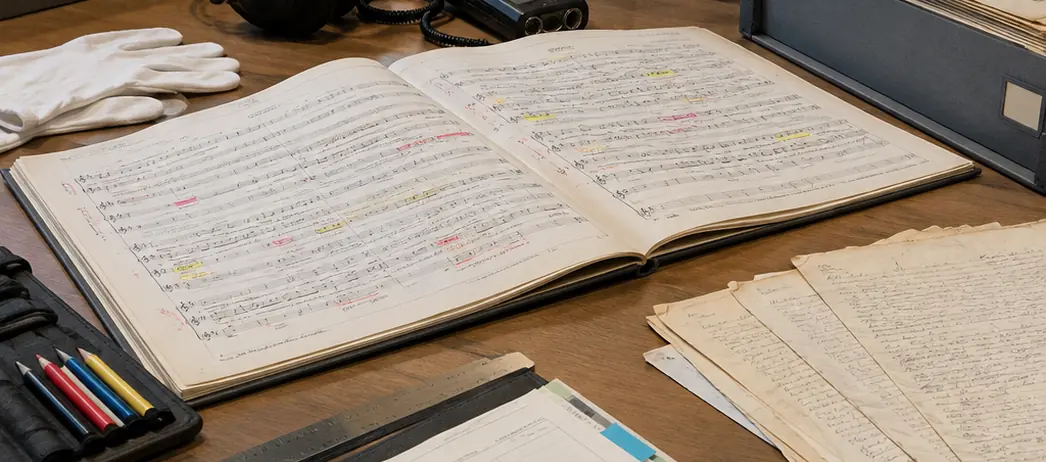
To construct the episode's narrative spine without relying on dry biographical clichés, our lead producer cross-referenced physical scans of correspondence from the Margaret Bonds Papers at Georgetown University Library Booth Family Center for Special Collections directly against the score's rehearsal markings. The letters exchanged between Bonds and her longtime collaborator Langston Hughes during the 1960s reveal the urgency with which both artists viewed civil rights advocacy through classical forms. We mapped specific epistolary excerpts directly to the thematic shifts between movements, letting their words establish the emotional stakes before a single note sounded.
Pacing the Spoken Word Against Orchestral Timbre
Radio hosts frequently commit the cardinal sin of talking over instrumental introductions, compressing the dynamic range of the music underneath a vocal mic. When you are airing complex orchestral textures—whether by Bonds, Ulysses Kay, or Chen Yi—ducking the master fader under a narrator ruins the composer's orchestration. In Bonds' score, the thematic weight relies heavily on sudden timbral shifts in the low brass and percussion.
Our audio engineer enforced a strict 1.5-second silent gap before low-brass and percussion attacks to avoid voiceover compression. We timed the spoken readings of the 1960s letters between Bonds and Hughes to resolve cleanly into room tone. When the sombre, lamenting brass chords of "Sixteenth Street Baptist Church" entered the broadcast chain, they hit the listener's speakers at full dynamic volume, allowing the orchestration itself to articulate the grief and defiance of the mid-century civil rights movement without over-narrating the climax.
Where Traditional Radio Clock Formatting Clashed With Bonds' Symphonic Structure
A 25-minute uninterrupted Segment B block—exceeding the standard 18-minute syndicated ceiling—became the defining technical battle of the production. Standard public radio syndication clocks are built to accommodate classical music that behaves like modular furniture, demanding a hard station identification and underwriting break right at the mid-hour mark. When assembling the master tape, we discovered that the standard syndicated clock's mid-hour break fell right between the first movement ("Decision") and the second movement ("March").
Splitting the harmonic bridge between "Decision" and "March" in Bonds' The Montgomery Variations to serve a 29:50 syndicated underwriting break strips the spiritual theme of its civil rights narrative arc. The resolve established in the opening woodwind statements of "I Want Jesus to Walk with Me" must pivot immediately into the kinetic, polyrhythmic footfalls of the boycott marchers. Severing that transition to read sponsor credits destroys the psychological architecture of the piece.
Preserve Harmonic Continuity: Never split a programmatic variation suite across an underwriting break when the thematic transformation relies on attacca or harmonically linked movement transitions. Restructure the broadcast hour around the score's internal climax.
We pulled the mid-show station identification break forward by 11 minutes, sacrificing 2 separate 60-second underwriting buffers from the mid-hour break so the entire seven-movement suite could air uninterrupted. This structural alteration required immediate coordination with our syndication network. We used a 48-hour distribution window prior to broadcast to send custom PDF timing sheets to local board operators across our affiliate stations. However, affiliate stations utilizing satellite-triggered hard-stop automation at 29:50 past the hour will truncate the seventh movement ("Benediction") unless local board operators manually switch their master clock to delay-override mode from the custom cue sheet. That technical boundary proved just how rigidly broadcast infrastructure resists non-standard symphonic pacing.
From Listener Direct Messages to a Regional Orchestra's Mainstage Season
Within 10 days of the initial airing, our production inbox logged 19 direct inquiries from conductors, university librarians, and artistic planners asking where to source the physical performance materials. While daily listeners sent messages reflecting on the power of hearing Black symphonic vernacular presented with unhurried reverence on drive-time airwaves, the most concentrated response came from practitioners who realized they had never studied a full-scale orchestral score by Bonds.
Programming unfamiliar symphonic repertoire by composers like Bonds, George Walker, or Adolphus Hailstork often stalls at the administrative level because music directors lack consolidated historical documentation to present to risk-averse boards. When a regional orchestra's artistic administrator contacted us requesting our broadcast script, we saw an opportunity to test how radio journalism could function as a direct pipeline to the concert hall. We compiled our historical notes, Georgetown archival citations, and movement-by-movement timing sheets into a four-page dossier.
The orchestra's music director used that exact broadcast dossier to pitch The Montgomery Variations to a hesitant programming committee. By demonstrating that a 54-minute public radio deep-dive had already generated measurable engagement among regular classical listeners, the conductor neutralized the board's fear of box-office alienation. Audience appetite for rigorous historical programming holds steady—listener retention across our drive-time blocks that autumn confirmed as much. After a 14-month lead time between the radio broadcast and the concert hall stage, the regional orchestra premiered the work during their 2022–2023 subscription season.
Auditing Your Next Broadcast Block or Concert Program for Structural Equity
Turning a single broadcast success into a permanent operational standard requires stripping away ad-hoc curation. After watching our Bonds episode transition from a radio tape to a regional orchestra's subscription stage, our editorial team codified a 3-step pre-broadcast verification protocol implemented across all subsequent 2021–2022 episodes. Whether we are featuring Florence Price or examining modern orchestral textures by Chen Yi, this framework prevents underrepresented repertoire from being relegated to novelty holiday slots or five-minute curtain raisers.
We established a 20-to-30-minute uninterrupted score allocation minimum replacing standard 5-minute overture slots across our primary programming blocks. To help fellow radio producers, music educators, and artistic planners replicate this model, we distilled our studio workflow into a strict pre-production checklist:
- Primary Source Verification: Cross-reference commercial liner notes against archival composer correspondence or manuscript holdings (such as university special collections) at least 4 to 6 weeks before final tape lock or program printing.
- Uninterrupted Score Allocation: Carve out a continuous 20-to-30-minute window in the broadcast clock or concert half, manually overriding automated mid-hour breaks that would bisect multi-movement programmatic transitions.
- Direct Score-Locator Notes: Publish exact publisher, rental library, or archival holding coordinates in the public episode show notes or concert program book so conductors and educators can immediately acquire the physical parts.
Pull your upcoming quarter's broadcast playlist or concert syllabus right now, replace one over-played five-minute overture with a substantial, multi-movement orchestral work by Margaret Bonds or her historical peers, and publish the exact archival source of the score alongside your public program notes.



Add Your Thoughts