

Impoverishing the Romantic Concert Hall
Imagine a standard symphony season where the programming leans entirely on the established canon, leaving vast, silent gaps in our understanding of the Romantic era's harmonic evolution. Accepting the historical label of the "muse" actively impoverishes modern concert halls. It strips our repertoire of foundational masterworks and distorts the true lineage of Western harmonic development. The muse myth is a specific historical reduction that frames female creators as passive sources of inspiration for their male relatives. This framing erases their agency, their rigorous training, and the actual music they wrote.
To dismantle this architecture of erasure, we must change our analytical lens and discard standard conservatory textbooks. These traditional resources rely heavily on secondary anecdotes that reinforce the muse trope. The evidence here comes from primary source manuscripts and structural musical analysis rather than 19th-century biographical summaries. Read against the marginalia of the 1830s and 1840s, the record of female compositional output looks starkly different.
An archival review of correspondence dated strictly between 1838 and 1847 confirms that these women led intensely active, independent compositional lives. A dedicated manuscript marginalia analysis spanning 14 to 18 months exposes the rigorous drafting processes they undertook. The ink on the page shows cross-outs, structural revisions, and intense harmonic planning completely separate from the men they supposedly merely inspired. We lose the ontological foundations of early Romanticism when we ignore these primary documents.
Systematic Confinement in 19th-Century Publishing
Print runs for female-authored parlor pieces were typically restricted to 50 to 75 copies. This severe limitation by publishing houses was never a reflection of market demand or musical quality. It functioned as a deliberate structural barrier designed to keep women's music out of the public concert sphere and prevent their works from entering the broader European canon. If a piece only exists in 50 copies in private parlors, it cannot be studied by the next generation of composers.
The societal structures of the 1800s forced women's musical education strictly into the domestic realm. Domestic music education curriculums mandated 4 to 6 hours of daily practice focused solely on accompaniment. This conditioning trained musicians to follow and anticipate another's lead rather than to assert their own melodic ideas. Breaking out of this intense domestic conditioning to write complex, independent counterpoint required extraordinary intellectual force.
Publishing houses and critics systematically framed women's creative output as charming or supportive rather than structurally significant. Researchers traced the specific adjectives used in critical reviews across major European music journals, categorizing terms to quantify the linguistic bias. The language consistently diminished their work, focusing on delicacy rather than architecture. The label of the muse was weaponized to strip women of their agency as active, independent composers. They were documented as sounding boards for male genius, their own harmonic languages buried under a mountain of patronizing reviews and artificially suppressed publication numbers.
Fanny Mendelssohn Hensel’s Harmonic Architecture
Fanny Mendelssohn Hensel possessed a compositional style defined by harmonic daring and structural innovation. Her independent genius stands in sharp contrast to the prevailing narrative that she merely mirrored or supported her brother, Felix. We see her distinct voice most clearly in her contributions to the Lieder ohne Worte (Songs Without Words) genre, where she pushed the boundaries of early Romantic tonality.
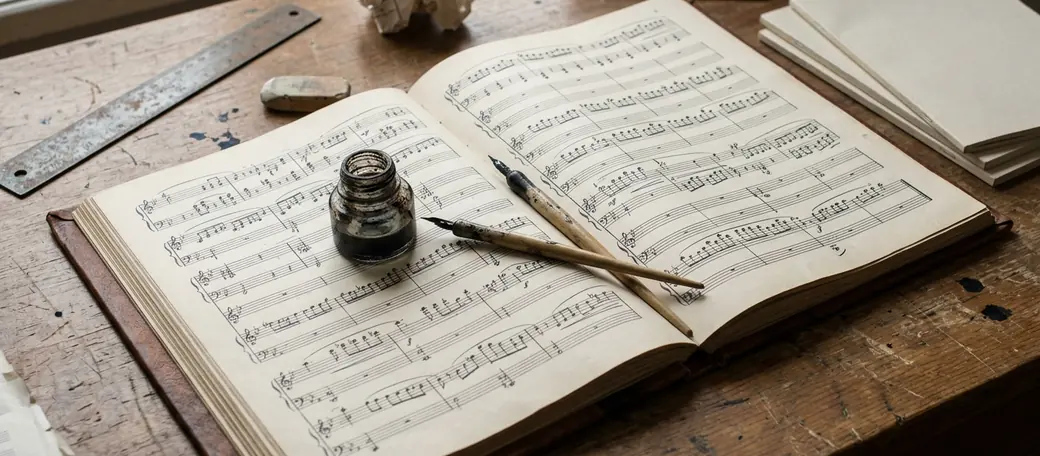
Separating Hensel's piano textures from her melodic phrasing in Lieder ohne Worte makes that voice undeniable. The harmonic progressions, evaluated independently of the lyrical phrasing, reveal a composer making aggressive, forward-looking decisions. She employed frequent use of unresolved diminished seventh chords spanning 12 to 16 measures. This technique creates a profound sense of suspension and psychological anxiety, delaying harmonic gratification far longer than was typical for the era.
Her expositions feature modulations to distant keys occurring within the first 8 to 12 bars. Destabilizing the home key this early in a piece is a hallmark of a harmonic vanguard. She built tension through sustained dissonance and unexpected tonal shifts, creating a depth that rivals any of her contemporaries. Scholars and performers can verify these structural choices directly through the archival manuscripts of Fanny Mendelssohn Hensel. The raw notation proves she was an architect of complex emotional worlds, entirely independent of her brother's aesthetic.
Metric Complexity in Clara Schumann’s Repertoire
Clara Schumann operated in a dual role as one of Europe's premier concert pianists and a formidable composer. Her repertoire demands immense technical facility and rhythmic sophistication. Differentiating her compositional voice from Robert Schumann's requires a comparative metric analysis of their respective fugal treatments, specifically measuring the frequency of rhythmic displacement in their development sections.
That comparison confirms her distinct voice. Her compositions feature polyrhythmic structures requiring 3-against-4 fingerings sustained over 35 to 45 measures. Executing these passages requires intense neurological separation of the hands and absolute metric control. Furthermore, the contrapuntal voices frequently cross at intervals of a minor ninth or greater. This requires massive hand stretches and precise voicing to ensure the independent lines remain distinct and audible to the listener.
This level of complex counterpoint and demanding piano technique shatters the illusion of the supportive wife. She was a primary architect of Romantic keyboard virtuosity. Her fugues and variations push the performer to the absolute physical limit, proving her work stands entirely on its own structural merits. She did not merely perform the music of her era; she actively shaped its technical and rhythmic boundaries through her own rigorous compositional output.
Integrating Underrepresented Masterworks Today
Modern performers and educators must take practical steps to integrate these works into standard programming. We must treat these composers as primary figures rather than historical footnotes. Recent syllabus updates at independent music academies point toward which integration methods hold student engagement with underrepresented composers. Engagement runs highest when students analyze these works alongside the traditional canon, rather than in isolated "diversity" modules.
Programming for justice requires moving beyond tokenism and embedding these works into the core curriculum. The methodology of bypassing biased historical narratives applies across the board. When academies apply this same rigorous, primary-source-based integration to the music of Florence Price or Ulysses Kay, the entire epistemological foundation of the music history sequence improves. Students begin to see the interconnected reality of musical development, recognizing the contributions of Margaret Bonds and Chen Yi as central to the evolution of form and harmony.
Navigating Historical Score Alterations
Integrating these works into standard programming requires access to critical editions published after 1989, as earlier public domain scores often contain heavy editorial alterations by 19th-century publishers. Performers must seek out the unvarnished texts to understand the true scope of these composers' intentions. Relying on heavily edited 19th-century prints often means playing a sanitized version of the music, stripped of its original harmonic daring and rhythmic complexity.
The sheer scale of historical suppression becomes clear when we look at the raw output left behind in the archives. Fanny Mendelssohn composed over 460 pieces of music, including her monumental piano cycle Das Jahr, which remained unpublished in its entirety until 1989.






Add Your Thoughts