


When a Commission Fee Cannot Cover the Parts
A young woman composer sits with a commission contract open beside her score. The orchestra’s name would look impressive on a programme. The fee looks less impressive against the work still to come: preparing a full set of performance parts, printing them on archival-grade paper and binding them to the ensemble’s specifications. She considers sending PDFs to the librarian. The contract requires physical materials, so that saving disappears.
The shortfall arrives at a particularly exposed point in the process. The music is written, but rehearsals cannot begin until every player has a usable part. Pages need to turn cleanly; cues and rehearsal marks need to agree across the set. The commissioning body receives the finished work only after the composer has paid for its delivery.
This is where a conversation about representation has to follow the money. A radio programme can give Florence Price or Margaret Bonds performance space and help listeners hear a wider classical history. A new commission asks a living composer to sustain that history into the future. If the fee leaves that composer financing production from personal savings, the invitation carries a hidden eligibility test.
Commission contracts should make the transfer of materials explicit: who supplies the paper, who checks the parts, who pays for revisions after rehearsal, and when those costs are reimbursed. I would read those clauses before treating the headline fee as compensation. Prestige has value, but it cannot pay a copyist’s invoice.
What the Orchestral Score Costs to Deliver
A finished manuscript is only one output of orchestral composition. Notation software, studio time, workshop musicians, score preparation and part extraction all draw on the commission budget. Some expenses arrive early, while the most exacting production work falls close to rehearsal, when a missed deadline can threaten the performance.
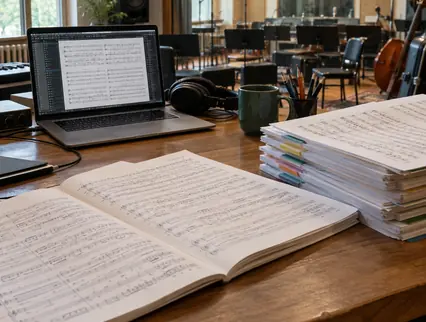
Copying is skilled musical work
Part extraction deserves its own budget line. A copyist checks instrument transpositions, page turns, rests, cues and consistency between the conductor’s score and individual parts. Dense orchestration makes those checks slower. Handing a raw software export to players shifts the cost into rehearsal time and increases the chance that an error reaches the podium.
A composer facing a small advance might devote all of it to professional copying, then carry software and studio bills as personal debt. That choice protects the ensemble’s preparation at the composer’s expense. It also reveals a weakness in budgets that treat materials as an incidental final task rather than part of making the work.
The burden falls unevenly. A creator with savings, family support or an institutional salary can bridge a late payment more readily than one covering rent from project to project. Women and BAME composers already fighting for room in classical programming may be offered an opportunity whose cash requirements keep them from accepting it.
Price the Parts: Ask for a separate materials allowance, a clear reimbursement schedule and written responsibility for rehearsal revisions before agreeing to the delivery terms.
How Grant Rules Reward Existing Access
Grant applications can demand almost as much strategic preparation as the proposed music. An applicant assembles scores, selects recordings, writes a project account, obtains recommendations and adapts the same work to each funder’s format. All of that happens before a funding decision.
The recording requirement is especially consequential. A composer with conservatory contacts may be able to call on performers and secure a polished live sample. A composer without that network may have a strong score and a carefully prepared synthesized mockup, yet struggle to meet a residency’s portfolio standard. Accepting mockups in emerging-composer categories can widen the entry point; live-recording demands in major orchestral residencies still shape who can advance.
Reduce the first hurdle
One useful grant redesign begins with a brief letter of inquiry. Reviewers can assess the proposed work’s artistic direction before asking shortlisted applicants to assemble extensive samples and references. That sequence saves unpaid labour for people who have little chance of funding and gives assessors a chance to examine potential before institutional polish dominates the file.
Rubrics need scrutiny too. “Merit” can become a proxy for access when assessors reward prestigious training, familiar recommenders and past commissions without asking how those credentials were obtained. Artistic judgement remains essential, but the rubric should identify what a score or proposal actually demonstrates. It should also give reviewers a way to consider financial need without asking applicants to turn hardship into a performance.
Public federal arts funding distribution reports offer a place to examine the wider funding picture. They cannot, on their own, explain a particular panel’s decision. To test access at application level, a funder should examine where applicants leave its process, what materials each stage demands and whose work its criteria allow reviewers to hear.
Why Back-End Royalties Leave a Cash Gap
Established composers and emerging creators often enter fee discussions with different leverage. A familiar name may arrive with representation, a commissioning history and a clear price. A less connected composer may be asked to accept a lower fee in exchange for exposure, even though the work requires the same score and performance materials.
Royalties are an unreliable substitute for cash during composition. Payment for a premiere must travel through reporting and processing before it reaches the creator. Rent, musicians and copying costs come due much sooner. When a contract places most compensation behind future performances, the composer finances the commissioning body’s present needs.
A legal representative can make that timing visible by mapping which costs arise before delivery and which payments depend on later performances. A revised contract that pays most of the fee on manuscript delivery brings compensation closer to the work performed. Composers without representation need the same protection built into standard terms rather than left to individual bargaining strength.
Publish the price before negotiation
Fee opacity makes unequal offers hard to challenge. An organization can announce a commissioning range, state whether copying and materials sit inside or outside it, and publish its payment milestones. That gives a composer a basis for assessing the offer before committing time to negotiations that may block other work.
Separate the Streams: Write the composition fee, materials budget and prospective royalties as distinct contract terms. Each pays for a different part of the commission.
Set a Fee Floor That Funds the Music
A workable minimum starts with the labour required to compose and orchestrate the piece, then adds the cost of preparing materials the ensemble can perform. An arts organization can build that floor by examining time recorded on past commissions and by pricing its own delivery specifications. A per-minute-of-music rate can make offers easier to compare, provided the agreement also accounts for instrumentation, production work and revisions.
Payment timing belongs in the standard alongside the total. An initial instalment at signing gives the composer funds during the creation phase; a substantial payment on manuscript delivery covers work completed before any royalty arrives. Materials should be funded when the composer needs to order them, rather than reimbursed long after the parts reach the players.
Funding bodies should reinforce that floor instead of undermining it. Grant rubrics can assess artistic potential and financial need while asking fewer applicants for costly, fully developed portfolios. Commissioning organizations can report their fee ranges and material allowances alongside the names on their seasons. Those measures make it possible to judge whether programming for justice extends to the people creating the repertoire.
The concert hall gains little from a broader programme if new voices must absorb losses to appear in it. Adopt an enforceable minimum commissioning fee that pays for composition and performance materials, and put the first payment in the composer’s hands when the contract is signed.








Add Your Thoughts