

What an Inherited Violin Syllabus Leaves Untaught
A narrow studio syllabus leaves violinists with a restricted preparation for contemporary recital expectations, changing orchestral programmes, and unfamiliar stylistic idioms. It also shapes a prospective student’s first impression of a department: whose music counts as foundational, and whose appears only after the serious technical work is finished?
At one collegiate violin department, the inherited requirements made that distinction explicit. Across an eight-semester undergraduate sequence, students chose from 45 approved concertos and 12 etude books. The lists contained no works by Black or Indigenous composers. Two concertos by women appeared as optional senior electives, both twentieth-century works.
The department committed to a two-year revision replacing 40% of its standard pedagogical repertoire with works by women and composers of color. The consequential decision was to put that repertoire inside the required technical sequence, where it would shape assessment, lesson preparation, and advancement.
Auditing the Route to the Senior Recital
Three studio heads and the music librarian spent six weeks examining 14 years of archived programmes and assessment documents. Their baseline covered 112 undergraduate degree recitals and 340 end-of-semester jury sheets from 2010 through 2023. They tagged composers by gender, race, and composition date to locate the points where the repertoire pipeline narrowed.
That distinction between approved repertoire and performed repertoire matters. An elective can sit on a list for years while the teaching sequence continues to direct students elsewhere. Jury sheets reveal what students actually prepare; recital programmes reveal which works survive the progression toward graduation.
The audit therefore reached backward from senior performances into the requirements that produced them. Freshman technical assignments, sophomore barriers, concerto tiers, and recital permissions belonged to the same system. A senior elective offered little leverage over choices already embedded in earlier semesters.
For a department undertaking similar work, the useful audit unit is the required learning pathway. Record where a composer enters that pathway, whether the assignment is compulsory, and which later assessment it prepares a student to pass. Programming for justice becomes concrete when access to repertoire changes at those decision points.
I would begin with the jury requirements before rewriting the recital catalogue. They expose the department’s working definition of a trained violinist.
Keeping the Technical Bar While Changing the Repertoire
An unrestricted substitution policy and a skill-mapped replacement policy give faculty very different decisions to make. The first asks whether a piece deserves inclusion. The second asks which existing requirement it can teach, how the student will demonstrate that skill, and how the jury will assess it.
The committee initially proposed open choice: students could substitute a work by an underrepresented composer for a standard Romantic concerto. During a November review, senior faculty challenged that approach over shifting mechanics and bow-weight benchmarks. The committee abandoned the open-choice model and adopted a formal technical screen.
The concern had a practical basis. Removing a familiar requirement can leave a teacher wondering where a student will encounter sustained passagework, difficult position changes, or controlled bow distribution. A replacement policy needs an answer at the level of the passage and the learning objective.
Testing the Score Against the Skill
Each proposed work had to satisfy at least three of five formal technical criteria before entering the syllabus. The criteria included third-to-seventh-position shifting in double-stops, sustained spiccato above 120 BPM, and polyphonic chord voicing.
That threshold operated as an admission screen. Faculty still needed to match a work’s particular demands to the requirement it would replace. A piece meeting three criteria could serve one stage of the sequence well while another piece supplied the remaining work elsewhere.
The department scheduled four 90-minute sight-reading and score-analysis workshops across the 16-week fall semester. Seven full-time and four adjunct violin professors played candidate repertoire, both alone and with staff pianists. Works by Florence Price, Grażyna Bacewicz, and Joseph Bologne, Chevalier de Saint-Georges, entered a shared teaching discussion before the syllabus vote.
Reading together made the debate more precise. Faculty could identify where a bowing pattern became difficult at tempo, how accompaniment affected ensemble coordination, and whether a technically exposed passage lasted long enough to test consistency. Those questions travel more readily between studios than general endorsements of a composer.
Keep the Benchmark Visible
A workable approval record should connect three things:
- The existing skill requirement and its place in the degree sequence.
- The passages in the proposed work that require that skill.
- The evidence a student must present at the jury, including tempo, articulation, and continuity.
This keeps technical accountability visible while expanding the repertoire through which students acquire it. It also gives an adjunct joining the department a usable teaching rationale rather than a list of unfamiliar titles.
Making Archival Scores Playable in the Studio
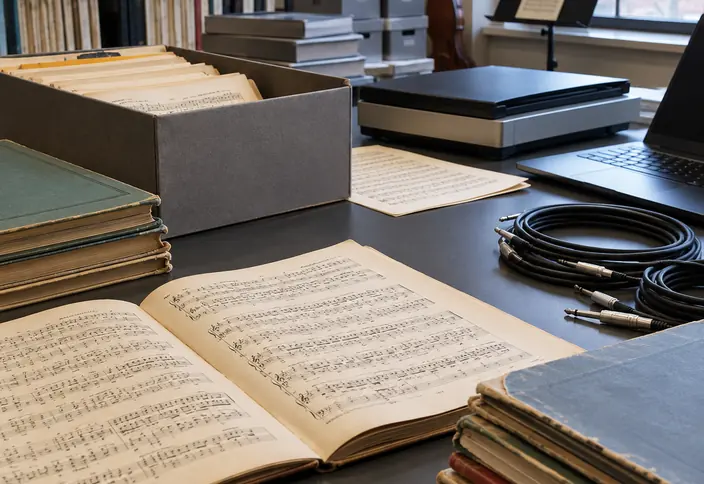
The early archival scans reached the accompanists, and the accompanists rejected them. Crowded, hand-copied nineteenth-century piano reductions and missing rehearsal letters made rehearsal unnecessarily difficult. Finding a score had solved the acquisition problem; preparing a usable performance set required another layer of work.
The violin chair and chief music librarian redirected internal funds to employ two doctoral composition fellows over the summer. Their task was exacting: engrave clean performance editions and produce separate, unedited violin parts that students and teachers could mark themselves.
High-resolution microfilm scans from three European national libraries took four to nine weeks per score to acquire. Digital engraving then required 15 to 25 hours per concerto movement. These lead times made edition preparation part of curriculum planning rather than a task to leave until repertoire assignments went out.
Over ten months, the department allocated $6,400 from internal academic enrichment funds to boutique print editions and graduate engraving work. The result was a physical and digital binder reserve containing 28 newly prepared performance sets.
Build the Performance Set Before Assigning It
The useful workflow joined library acquisition to studio preparation:
- Identify the source. Locate the violin part, accompaniment, and relevant edition information together. Public discovery resources such as the Library of Congress digital sheet music collections provide one starting point for historical score searches.
- Establish reproduction permissions. Confirm public-domain status and applicable reproduction terms before commissioning engraving or circulating files.
- Prepare rehearsal materials. Give the soloist and pianist legible notation, consistent rehearsal references, and workable page turns.
- Separate source text from teaching marks. Preserve a clean violin part alongside fingered and bowed study copies, so later users can distinguish notation from interpretive decisions.
- Deposit the complete set. Keep the accompaniment, solo part, edition notes, and teaching copies together in the reserve.
The clean parts changed the student’s task. Instead of purchasing an edition already dense with inherited solutions, students had to develop fingerings and bowings on uncluttered pages. That made editorial decisions available for discussion: where to change position, which string to use for a phrase, and how a bow division supported its direction.
For departments without dedicated music-library staff or engraving stipends, the practical route is to begin with modern commercial editions and reserve manuscript recovery for a later phase.
The library reserve became teaching infrastructure. Once a complete set existed, the next student could begin with a playable score rather than repeat the acquisition work.
Distributing the 40% Requirement Across the Degree
Eight replacements among 20 required studies made the lower-division change tangible. Students retained a substantial sequence from Kreutzer’s 42 Etudes and Rode’s 24 Caprices, while selections from Bacewicz’s caprices, Saint-Georges’s sonata allegros, and Maud Powell’s technical transcriptions entered the same assessed progression.
The committee distributed the replacement requirement across the semester sequence instead of creating a separate diversity semester. Students encountered the expanded repertoire while building technique, crossing progression barriers, and preparing major solo works. Inclusion therefore carried the same assessment consequences as the established repertoire.
Match the Assignment to the Year
- Freshman technique: place the new selections within the existing technical sequence. The assignment should name the relevant bowing, shifting, articulation, or coordination objective and identify the passage where the student must demonstrate it.
- Sophomore technique and barrier: complete the lower-division replacement of eight among the 20 traditional required studies, while introducing the revised concerto choices at the progression threshold.
- Junior concerto study: use the expanded concerto tier to develop sustained interpretation alongside technical preparation. Students should work through formal structure, harmonic direction, and collaboration with the pianist.
- Senior preparation: build recital choices on repertoire and interpretive habits already encountered during the degree, giving students a foundation for independent programming.
For the sophomore barrier and junior concerto tiers, the department added Amanda Maier’s Violin Concerto in D minor, Samuel Coleridge-Taylor’s Concerto in G minor, Op. 80, and Florence Price’s Violin Concerto No. 1 in D major. These joined established Bruch, Mendelssohn, and Lalo selections.
Those additions broadened the harmonic and stylistic material students met before their graduation recitals. Faculty could retain familiar technical reference points while requiring students to make musical decisions in a wider range of works.
Count Assignments, Then Check Coverage
The full degree required 16 major jury selections and 40 technical etudes across eight semesters. Under the revised sequence, each graduating violinist would perform six to seven major solo works and 16 etudes by women and composers of color.
The arithmetic needs care. Forty percent of 16 major selections falls between whole works, so a degree-level count of six to seven reflects the available assignment units. The etude requirement yields an exact count: 16 of 40. Neither figure measures lesson minutes or practice hours.
A practical tracking sheet should therefore record major works and technical studies separately, with the semester and technical objective attached to each assignment. Counting both categories prevents a department from meeting its target through short studies while leaving concerto progression substantially unchanged.
The same sheet should distinguish the original eight lower-division substitutions from the full-degree total of 16 replaced etudes. They describe different spans of the curriculum, and keeping their denominators visible makes the policy easier to administer.
What the Jury Could Hear—and What It Needed to Measure
During the second full academic year, the department conducted 68 undergraduate jury examinations across 32 weeks of instruction. The assigned works averaged fewer than three commercial recordings on streaming platforms; standard warhorses had more than 50.
That difference altered how students prepared. Those working through the new repertoire had fewer ready-made interpretations to consult and had to prepare their own fingerings and bowings. The jury could ask how those decisions served a phrase, how they held together under pressure, and whether the student could explain an alternative.
Separate Technical Scores from Interpretive Ownership
To examine the curriculum change, the string division chair compiled anonymized adjudication rubrics from the first four jury cycles under the revised rules. The comparison used the preceding three years of traditional-repertoire juries and separated intonation, rhythmic accuracy, and stylistic phrasing.
Those categories address different questions. Intonation and rhythmic accuracy test execution against familiar departmental expectations. Stylistic phrasing asks how convincingly the student organizes the music. Keeping them distinct makes the evaluation useful: enthusiasm for unfamiliar repertoire should coexist with close attention to technical delivery.
Interpretive ownership also needs something more concrete than an adjudicator’s impression of commitment. A student can identify the harmonic arrival that shaped a bow change, demonstrate a second fingering, or explain why a repeated passage receives different articulation. These are assessable decisions grounded in the score.
For the jury conversation, three prompts make that reasoning audible:
- Which passage required the most substantial fingering revision, and what musical problem did the revision solve?
- Where does the bowing support the phrase structure, especially when the easiest distribution would suggest another accent?
- How does the accompaniment change the timing or direction of the solo line?
These questions connect independent preparation to the same technical standards used throughout the degree. They also give faculty a way to discuss engagement through specific musical choices rather than through the familiarity of the repertoire.
The sharpest measure sits in the required workload: a graduating violinist now completes 16 of the degree’s 40 technical etudes in repertoire by women and composers of color that previously had no place in the department’s curriculum.



Add Your Thoughts